Showing posts with label *China. Show all posts

Monday, 21 May 2012

The Great Hiatus

"We will return shortly ... maybe after 2 months"


... Yeah. Procrastination and pretending to be busy at work was probably the reason.

Getting back;,here are two interesting stories.

So it seems like there's a growing number of Chinese Companies defaulting on their contracts; why you cunning bastards. Can't blame them since there's their economy has been going downhill since last year. Now that demand on their side is weakening the whole world is in panic mode; affecting countries like Australia. Could this mark the downfall of China's economy - therefore the world? Fuck no. I'm pretty sure its temporary. I had a good chat with a newly made acquaintance who thinks that the China's economy isn't really slowing down; the Chinese government is artificially cooling (with the relevant policies) the economy to make sure they don't grow 12" inches too long or to a point where inflation comes on their faces harder than a brick wall. In his words; Effective first, then Effeciency. So I guess the government is making tweaks to make sure growth is stable in the long run; hell any GDP growth of <5% should be better than any of the already developed countries.

On another note, I recall reading an article on South Korea being pressured to halt their imports of oil from Iran; although America agreed to allow them to continue all non-oil related transactions, EU is starting to throw a fit and rejected any exemption appeals by the Korean government. Not a big fucking deal to me anyway but I was drawed towards this particular line in one of the articles;

European insurers have a monopoly on shipping insurance, so it will be extremely difficult to find replacements

How come they have monopoly over shipping insurance; in particular, for Oil Shipments? I think that is a huge fucking question that needs to be answered; I'm demanding it to be answered. Could it be because of the fact that they have been in the industry so long? Is it because only they have the capital for it? I doubt it. This is definitely something worthwhile doing a bit more research on.

Feels good to be writting again.

Tuesday, 13 December 2011

The Chinese Government; Keeping the World in the Dark

Gotta love them pandas

I recently came across this 10 page article (if you print it out) about how the Chinese Government controls certain economic and political aspects of the country. As I read through two things started to happen; I become more and more curious, at the same time even more clueless about what they are doing - a total paradox. But keeping to the point, let me just elaborat on what they're doing as of now;

Now to put it in simple terms, the Chinese Government has a policy where, for transactions conducted in US Dollars, all the money has to be forwaded to their Central Bank, which is then to be exchanged with the Yuan Renmibi - this is apparently a must as they treat dollars as contrabands! Now what do they do with the money? They buy US Dollar denominatd government bonds. Now, if the buying of bonds were only limited to millions, I can understand, but apparently it runs in the billions (refer to chart below).


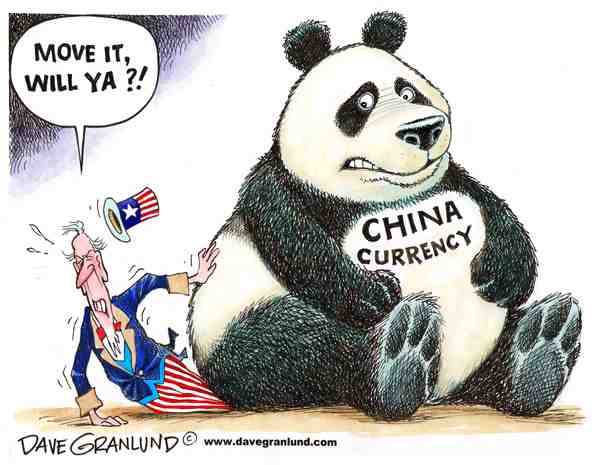
This is the prime reason why some governments are crying foul play; as this is the prime reason why their currency is undervaluated - to a point where the American Congress nearly went through the Exchange Control Act, and could be the reason why they've been targeted for Trade Protectionist Policies. If you look at their exchange rate, for a period of two years - there have been miniscule if not no major volatility against their exchange rate with the USD, even during the 08/09 financial crisis.


So what does this show? Clearly, a sign of government intervention. Many had hoped for the Chinese Government to change after their ascension into WTO - but apparently based on two articles from the Economist; much of their economic policies and political structure remains the same despite a significant amount of pressure to become "Westernize" and open up their market. This system apparently is much resented by the Chinese Government who prefers to have a stake (even a small one) in all if not the majority of the private entities running in China; for the sole purpose of control.

Now, in actuality, what the world is concerned about is their transparency - What do they plan on doing with the bond? There have been speculations that once reaching a certain threshold, they would do a firesale - but this would in turn hurt them as well as a healthy American economy would be essential to their Export-Driven economy, to which America is a big customer. So if this isn't the case, why don't they spend the money domestically? Why bother buy bonds when you can build infastructure? Well the answer to this is apparently as they build more and more manufacturing plants, major constructions shifts to public utilities would drive their inflation rate to the moon - and when that happens, a global rise in inflation would eventually come.

I believe that this is something long term - my experience which Chinese people, regardless of where they are born is that they have two distinct characteristics; the natural ability to make money and a very good long term vision. So whatever most pundits perdict in the moment is particularly off track - only the Chinese would know, and I'm pretty sure its something more which would develop within the following decades rather than years.  


In any case, keeping the world in the dark would only result in the Chinese Government open to scrutinization by the Western Media and Government. What I can see is definitely, a clash of ideologies from the Capitalist West, to the Communist / Socialist East. Within the coming decades, we would probably see a second Cold War; using not spies as weapons but rather dollars, purchasing power and economic influence.

Thats something new to look forward to.

Tuesday, 18 October 2011

China; Inflating Asia Pacific

Its because the west wants it!

Here we have an article explaining the effects of China's rate of inflation; for every 1% increase in rate of inflation in China, this would gradually lead to an increase in inflation of 25 to 50 basis points in the Asia Pacific Region - worse could even drive global commodity prices by 5%. Referring to my previous post (see Assumption 3), I expected for such a thing to happen. See? I told you!

Damn I'm good!

Thursday, 6 October 2011

The Second Plaza Accord

Be smart; Why not have both?

Recently, America has been developing a bill called the Currency Exchange Control Act to penalize China for undervaluing its yuan - and the Chinese are not happy with it. Although a number of Senators agree on imposing the act, others on the other hand, are much more skeptical if not oppposed to it. The funny thing I find about this whole drama is that America claims that the undervalued Yuan (see how Chinese & Indian government undervalues their currency) has resulted in the loss of jobs, in addition to the widening trade deficit between US and China. Some are claiming that America is indirectly trying to push China into the same position it did to Japan through the signing of the Plaza Accord; resulting in a devastating deflationary spiral in which Japan has been suffering over the past 20 - 30 years.

Now to be frank, I couldn't agree more on how America is playing the dirty game again. They did it to Japan under the banner that it would reduce trade deficit but it is nothing more than just a political ploy. What I think the American government is trying to do is push the attention away from them by using external distractions. Despite all the calls on how Chinese yuan is undervalued, the new Big Mac Index suggested that the Chinese Yuan is not severely undervalued as it is claimed to be (although this itself has its own limitations). Another key point which was mentioned is that the passing of the bill may have more harm on America's exports to China than imports; fits the bill - neither benefiting  both parties.

Its funny how despite strong indications that the global economy is heading towards a double dip recession, we have countries like America (as well as Argentina and Brazil) trying to enforce trade protectionism policies, claiming that it would help put their economy back on tack where in fact, the risks of it backfiring is apparent. But like all of the things the American Government has been doing for the past 10 years; its nothing more than a political ploy. It seems that they're much more encapsulated in trying to find an external explanation to the public rather than taking the blame themselves, and rather than thinking about the American public they have been selfish; affecting the entire world at the same time.

I hope they're happy with what they're doing.

Thursday, 15 September 2011

The Heat Of Financial Volatility

Very nice I like very much

Turns out the sneaky Chinese government finally came out of the closet by professing that in return for buying European bonds, the EU should reciprocate by granting them "market economy" status. Pretty smart eh? I've always known that the Chinese are a bunch of sneaky people. I've always had a sense of respect for them, until this Korean guy I met told me about his opinion on the country and its government. It all came much clearer when he reminded me of the country's kanji characters; "中国", where "中" means "centre / middle" and "国" refers to country. Get it? They see themselves as the centre of the world.

On another note in relation to the current Global Financial Meltdown; the one that has been hogging all of my blogspace of late to a point where I cant find any other shit to write about since its all over the news, Steve Forbes openly criticized Barrack Obama's stimulus package by quoting Japan's experience in dealing such matter; that they have had 15 stimulus packages in the last 20 years, and the outcome? Nothing. Frankly, I couldn't agree more on this but there are vast macro and microeconomic characteristics between United States and Japan (some discussed here), so a set of stimulus measures which doesn't work in Japan, might work in United States and vice versa.

The funny thing I find about this whole ordeal is how America keeps telling Europe to get their shit together but they can't even handle their own problems. This entire charade is too politically intertwined; stimulus package is tied to America's next General Election, Europeans can't think as a united entity and China is buying debts not for investment purposes, but for political gains. It's like the whole world is a fucking stageshow!

Think about the people you twats.

Tuesday, 13 September 2011

Where Are We Headed Part 2

But then the sun will go down again!

In a continuation of my previous post, where I somehow feel that the world is heading into a period of stagflation, let me justify that this was made based on three critical assumptions, where the fulfilment of all three (not either one) would definitely plunge the global economy into a period of stagflation;

Assumption 1 ;
If America fails to reduce and control its fiscal deficits; the downgrading of the American bond is not as much of a threat when compared to its inability to control its own budget. What happened subsequent to the downgrade was the lost in investor's confidence (from individuals to small companies) since, if the market really thought that America couldn't pay its debt, China would already be on a fire sale since they are America's biggest lender.

Assumption 2 ;
That unless Europe either kick the shit out of Greece out of Europe (for failing to meet their fiscal target), increase European Financial Stability Fund's funding capacity, or actually act as a fucking United Europe instead of whining like a bitch about how they have to pay for the other countries' fuckups, the region's continued instability posses a massive risk to the global economy. To put it simply; they need to stop being politically divided and stand united.

Assumption 3 ;
Unless China controls its rate of inflation, the global inflation rate would continue to rise. This is simply driven by the fact that the Chinese just manufacture too much shit; everything for $1 dollar. If the domestic prices continue to increase, then this would gradually lead in an increase of prices for their exports. Then, we can start getting ourselves busy by digging our own graves.

Luckily, it seems that China's inflation rate seems to be cooling off of late, and by the looks of it the government plans on putting their consistent interest rate hikes to a halt to accomodate growth. But the prospects for America still looking uncertain as they plan for another massive job growth package, while at the same time, urging European countries to bail out their debt-riddled neighbors under the pretext that "stronger members should absorb the costs; else, the regional effects would cost much greater". As Assumption No. 3 slowly cools off, we still have the first two to worry about; would we still be headed towards a global stagflation?

By the looks of it, the indicators are too strong to suggest otherwise.

Friday, 9 September 2011

Where Are We Headed Part 1

Coming soon to a store near you.

In the west, we have America's debt ceiling crisis (which remains partially unresolved), with Europe on the verge of kicking Greece out of the eurozone for failing to meet their fiscal targets; being one of the conditions they accepted when receiving the bailout fund from the European Financial Stability Fund / European Central Bank. I knew that this whole debt-crisis bullshit would somehow spread to the east, but I didn't expect it to have such an impact to a point where Fitch Ratings changed their outlook to China to negative, with a high probability of downgrading their bond ratings as well; including Japan.

Although numerous organizations are confident that chances for a double-dip recession or a meltdown similiar to 2008 are low, the outlook is still bleak, worse, we might even be heading towards a total global stagflation. Personally I believe this is the only direction in which the global economy is heading, and the signs are evident. High inflation, with moderated or low economic growth leaves legislators and central bankers with a massive headache. The South Korean government is one of the many countries currently experiencing this issue.

Despite all this, OECD has called for central banks to maintain their interest rates, wheras the IMF has urged countries to opt for stimulus packages or introduce some measures to develop growth (provided that they develop a credible mid-term debt control strategy) instead of focusing on short term austerity measures. These options however, are extremely tight and limited; not many countries (especially ones which are currently debt riddled) have the luxury executing anything else except an expenditure cut. So where does all this leaves us? In a shithole without a doubt.

Maybe Paul Krugman can come up with a Plan C this time?

Monday, 5 September 2011

World's Solar Panel Industry

We needz moar energi!

I have always been under the impression that America is the world's leader in terms of innovation, technological development and advancement in sciences. But with the closure of some of the Solar Manufacturing Companies; some backed by Barrack Obama himself, citing stiff competition from their Chinese counterpart, is this a tipping point where soon we will see China lead the way for solar panel developments?  It seems that solar panel manufacturers in South Korea are also suffering due to the loss of their American competitors and Chinese competition. Surely this is a sign predicting a shift in the World's Economic Centre of Gravity?

Cliche, but only time will tell.

Wednesday, 3 August 2011

China's Economy : Export or Domestic Driven?

Y u no tell me teh tru storeh?

    In a recent article by McKinsey Quarterly which I nearly fell asleep reading, the author suggested that the perception that China is turning into a major Export-driven economy (much like South Korea and Japan) is somewhat untrue. The author proceeded to introduce his own theory called Domestic Value Added Exports or simply abbreviated as DVAE which calculates China's exports by subtracting total exports from imports used in the production of goods and services which subsequently are meant to be re-exported. This is done to counter the following issues when dealing with conventional methods;
  • Overestimation by failing to remove imported goods (raw materials or components) which are used for manufacturing and subsequently re-exported. This is particularly evident when measuring the contribution of total exports to the GDP.
  • Underestimation as a result of the inclusion of finished imported goods which are then used for domestic consumption when using the Net Exports method (export less imports).
    The results from the application of DVAE (see article) in measuring China's actual exports indicated that China's exports seems to be overestimated, and actually slowing down within the past couple of years. Personally, I do think that the perception of China being an export-driven country is somewhat untrue. I think that come 10, 20 years, they would shift away from being a manufacturing-based country into a domestic-led economy, as evident in most developed countries. Let's face it, Chinese people are good at making money. They're a lavish good spender too.

    In another article relating to China's rising domestic consumption and disposable income, much has been discussed about the Chinese mentality of parading their personal belongings, coupled with a thrifty attitude, unlike their western counterparts. This sort of mentality is apparently a direct result from the constant years of the oppression by the communist state. But whether they will continue their domestic consumption will continue or not, much depends on whether the government is competent enough in battling key issues such as the country's inflation rate, risk of overheating, and its fiscal or monetary policies. The last thing the country would want to face after years of constant growth and trade surpluses is to end up in the middle income trap.

That would suck.