Showing posts with label Food For Thought. Show all posts

Monday, 28 May 2012

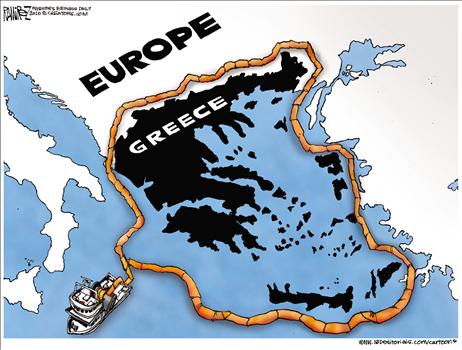
Grow Up Greece!

"Cage them! Cage them now!"

To be a single nation or not to be? That is the question.

In order to answer this question, another question must be answered beforehand - would Greece be able to pay off their debts? Clearly, the answer is no. Knowing thism Greeks must unite and take the necessary measures in oreder to contain their financial problems - but the problem is even the citizens themselves don't know who to elect. Reason being? All the candidates speak of austerity measures which is extremely unpopular with the public.

Are fucking retarded?

Its high time that you put a sock in it after years of binge spending. You want to tell me you're unwilling to cut down your spending? Isn't that a bit childish? Look at how Koreans were willing to give their personal gold during the Asian Financial Crisis 97/98 just to help their country to get out of the debts in which those IMF & World Bank assholes put them into.

Get your act together retards!


Monday, 21 May 2012

The Great Hiatus

"We will return shortly ... maybe after 2 months"


... Yeah. Procrastination and pretending to be busy at work was probably the reason.

Getting back;,here are two interesting stories.

So it seems like there's a growing number of Chinese Companies defaulting on their contracts; why you cunning bastards. Can't blame them since there's their economy has been going downhill since last year. Now that demand on their side is weakening the whole world is in panic mode; affecting countries like Australia. Could this mark the downfall of China's economy - therefore the world? Fuck no. I'm pretty sure its temporary. I had a good chat with a newly made acquaintance who thinks that the China's economy isn't really slowing down; the Chinese government is artificially cooling (with the relevant policies) the economy to make sure they don't grow 12" inches too long or to a point where inflation comes on their faces harder than a brick wall. In his words; Effective first, then Effeciency. So I guess the government is making tweaks to make sure growth is stable in the long run; hell any GDP growth of <5% should be better than any of the already developed countries.

On another note, I recall reading an article on South Korea being pressured to halt their imports of oil from Iran; although America agreed to allow them to continue all non-oil related transactions, EU is starting to throw a fit and rejected any exemption appeals by the Korean government. Not a big fucking deal to me anyway but I was drawed towards this particular line in one of the articles;

European insurers have a monopoly on shipping insurance, so it will be extremely difficult to find replacements

How come they have monopoly over shipping insurance; in particular, for Oil Shipments? I think that is a huge fucking question that needs to be answered; I'm demanding it to be answered. Could it be because of the fact that they have been in the industry so long? Is it because only they have the capital for it? I doubt it. This is definitely something worthwhile doing a bit more research on.

Feels good to be writting again.

Monday, 26 March 2012

Korea Fastfoward?

I think its a Chinaman and nota Korean on the right side ...

As much as Japan is changing (refer to previous article) and how Korea is overtaking Japanese Companies, here's a newer area in which Korea is overtaking Japan in. Come on you Japs, what the hell are you guys doing?

Thursday, 15 March 2012

Why I Stopped Learning Japanese

Impossibru!

This is why. I've always wondered why there are elements of incest in some of their mangas and animes; apparently much like how England outcasted convicts to Australia, China sent incest-lovers to Japan.

Mind-blowing.

Wednesday, 8 February 2012

Linguistics with Trade & Economics

Parle vu Englisheru?

Very thoughtful argument on the impact of language on trade and integration of the economy into the world. I do believe language does have an influence somewhat (e.g. my belief that one of the reasons Korea is surpassing Japan stems from the fact that a lot of Koreans are open / willing to learn English; to the extent that a lot of Koreans spend their highschool years overseas in English Speaking countries) on the economic development of a country. I think claiming that learning other language is "useless" is extremely one-sided. The exchange languages, apart from English, generates economic activities itself; through cultural mediums be it tangible or not. Should the world unify and speak one language; wouldn't it be a dull world?

Be damned if it wouldn't!

Friday, 3 February 2012

Repatriating Koreans

Picture totally unrelated. Seriously.

A bit off topic - but I plan on making this a regular thing.

This is an amazing article about how the founder of Ticket Monster (Dan Shim) quit his job at a reputable consulting firm (McKinsey) to do his own startup - very inspirational indeed. Remind to self; start doing your own research and brainstorming sessions.

Tuesday, 31 January 2012

State Capitalism

Didnt really get the comic but close enough

Here we have an article about the argument (mostly) against State owned Capitalism; e.g. companies in China, Petrobras etc. Let's get straight to the point; it argues that State owned Companies are ineffecient, breeds corruption and cronnyism, with strong manipulation and control by the government. Not to be a socialist / communist myself, but I think in some critical areas / sectors of a country (e.g. Energy & Utilities, Food Supply) it could be rather useful for a country to manage it from afar by owning a majority of the shares. I blatantly disagree if you were to say that all entities should be privatized as if you did it; you'll end up being like America.

The questions is why? and how?

You want to talk about corruption and cronnyism? What about all those companies and corporations who sponsor Presidential Campaign ads, only in turn, make the President of one of the world's economic powerhouse their puppet - much like corruption? sounds like cronnyism to me too. Companies being ineffecient? Ineffecient in terms of making money; but not necessarily ineffecient in terms of serving the people socially. Manipulation and control by the government is essential since to me, I find that no coporation should be more powerful than the government; else people would suffer; simple cases, America, United Kingdom, South Korea. Fine they have a larger GDP Per Capita - but look at how the underprivellaged are treated (those with no money) and look at how they spend?

But of course, this is a contentious issue.

Still open to discussion.

Monday, 30 January 2012

Why He Needs To Come Back

Ex-PM, 86 Years Old, still runs it Like A Boss

Despite being past his prime, he still exerts a strong influence over the country, while at the same time displaying hit wit and wisdom (with a tinge of criticism) in his latest public appearance. Always brings out goods points (but arguably not all the time); but I've always been an advent supporter of his Look East policy, condemning the West for their extravagant spending, and the mentality that they will always be rich.

Come back to us bro.

Monday, 16 January 2012

Overdependancy On Credit Rating Agency

Oh relax Sarkovsky. It just means that a woman can manage their finances better than you.

This is a good article on how investors should not rely too much on Credit Rating Agencies - much like how professional violinist, olympic judges, and wine critics lack consistency in their judgement. Humans by nature are prone to bias hence, we shouldn't solely rely on other individuals as a proxy to our own critical thought process and judgement.

Tuesday, 20 December 2011

Trade Mirage?

Thats one hell of a Yao Ming

I'm somewhat skeptical about this short brief on The Economist on how emerging economies will be importing more than developed countries (forecasted to take place 2012 / 2013). Referring to the chart below, we can see that ever since the end of 1990s / start of 2000, emerging markets continue to increase their stake in the share of world imports. My first question would be - is the percentage valued in Unit Volume or Value? It is kind of a stupid question but there are different intepretation results; although I think that it is highly unlikely that they used Unit Volume to represent the graph.

Second of all one must understand this set of statistics takes into account manufactured goods, commodities and raw materials - to which without a doubt the emerging economy is eating up; therefore somewhat misleading. Increases in imports could mean massive increases in capital goods and intermediate goods for further use in production and does not necessitate that the domestic consumption in emerging economies is larger than that of developed countries. Just because the West are importing less, does not mean that they're losing out - we still haven't factored in or do a cross-comparison on imports and exports of services to which the West still has a global presence.

Lastly, we need to understand that most of the imports done by emerging markets are probably for the purpose of investment, with a higher probability for re-exports purposes. Its too apparent, even in the article in which I wrote about in my last post, countries like China are still saving up - preferring to mediate growth through savings rather than enjoy the wealth they have gained thus far. I believe the graph is far for complete - if a comparisson of imports is to be made they should also include the types of products in which each of the two sides do. There must be a movement - one would import more of something whereas the other would import less; the question is, what?

Looking forward to see the actual trend next year.

Monday, 12 December 2011

Bloody British

Meeeeeeeeeee

How come the Brits are always selfish? Can they not see the benefits of an integrated economy? This would be the best time / opportunity to be supportive of the entire EU system. But no - they just have to be the eccentric one (like they always have) in the entire bunch. Bloody brits!

Tuesday, 29 November 2011

Japanization

Soon my friend, soon enough ...

An article I found on Japan; despite all of its accumulated wealth, the country still lacks maturity, and unwillingness to "grow up". A bit confusing, but still interesting nonetheless.

Friday, 18 November 2011

Diasporas; Benefits on Having Immigrants

I used to work as a Hooker - as in a person who hooks things.

I love how they titled the topic of the article which I was reading - magic indeed. Based on the article I was reading, migrants to a foreign country can actually be beneficial based on several key reasons ( map source can be seen here ) ;
  1. The "diaspora network" - where one could actually benefit in terms of the networks in which the migrant has to his/her country of origin. In other words, companies/institutions hiring them may not be limited to local networks alone but also be given the opportunity to expand its operations outwards.
  2. Spreading money - it is a fact that in general the migrants will be earning more than they would compared to working back home; repatriation of their monies to their homeland therefore would benefit both the domestic and foreign country.
  3. Innovation carriage - upon returning to their country of origin, apparently many would set up companies carrying with them the knowledge and experience in which they have gained overseas; allowing their countries to develop.

If we were to exclude Hong Kong (although they have that two government one country thing) from the map; Malaysia would have the second highest number of Chinese emigrants overseas. Although technically speaking, this is entirely wrong - its too apparent that these figures take into account Malaysian-born Chinese (but in reality, as a result of having a large number of dumb Malay politicians they're still treated as China-born Chinese).

But to be fair bringing immigrants into a country is not all that well - if you examine the article earlier, it talks mostly about high skilled immigrants, and by right they would benefit any country they go to. What I believe is meant to be of much more concern is low-skilled immigrants (particularly evident for Malaysia) and how it depresses local wages for works in similiar category, carrying market distortion effects. How would labors of this category be beneficial overall for a country? Repatriation of wages back to their home country is applicable, but what about carrying valuable contacts, innovation or creativity? Even if there were to be any, the amount would be minimal.

High tide for change?

Friday, 11 November 2011

Resource-rich Countries; Cursed or Blessed?

True - at least, at the rate we're going.

In a blog post at one of my favorite blogs / author, a recent study was conducted to refute a research paper claiming that countries with natural resources tends to result in slower economic growth compared to those which are lacking in natural resources. The so called Resource Curse (not to be compared to Dutch Disease) claims that the abundance or availability of natural resources within a country would eventually lead to unfavorable economic outcomes compared to countries which are bare stripped. Since I have yet to find the time to read both papers (will probably write up a summary plus my own personal opinion into it), I'll start by analysing both the Resource Curse and Dutch Disease terms to see whether both of them are justified.

Resource Curse essentially states that countries rich in natural resource tend to grow much slower than countries without them. Based on my readings, the curse is meant to affect a country in several ways;
  1. Ineffecient Government System - Revenues from natural resources tends to place the government in a complacent position, in addition to not needing to develop an effecient taxation system (therefore, the public will not scrutinize the government as they pay a miniscule amount of tax). Naturally, arguments over budget allocations would also ensue between each government departments and agencies resulting in a further ineffecient system; emphasizing on one's needs rather than the people.
  2. Revenue Volatility - During peaks of commodity prices, both the government and private sector will attempt more aggressive and expansionary policies; borrowing excessively without any proper justifications or evaluations. This may result in bankruptcy or large amounts of debts due as a result of the illusion from the high price of natural resource.
  3. Non-diverse Economy & Human Capital - Naturally, the country's economy and human capital would encircle around the natural resource due to the high revenue it which it brings in. There are also claims that this would eventually result in the country neglecting its education-infrastructure, as resource-extraction does not require a large number of highly skilled and talented workforce.
On the other hand, the Dutch Disease refers to the relationship between increase in dependance of natural resource exports resulting in a decline within the manufacturing sector. Essentially, the term refers to the shifts from the manufacturing sector, to both the natural resource sector (be it in the form of raw, manufactured goods or service related) in what is coined as both direct (manufactured) and indirect (services)deindustrialization. In order to minimize the effect, the revenues should be stored or invested abroad (through soverign wealth funds for example) and then revenues brought back over time in order to allow a more stable flow of income (something which I think Brunei is doing; rich, prosperous, and definitely resource dependant - they even have their currency pegged to the Singapore Dollar).

So.

What does all of this tell us? That at the end of the day, essentially (the way I see it) is just how you manage your resource. Now apparently the newer paper does not find any correlation or links between natural resource and economic growth (at least not negative; in fact they found some positive relationships). You can either go with a capitalistic approach (Netherlands, America) or a more socialist approach (Brunei) however at the end of the day, its the corruption-free and effecient management that truly matters. Despite America's criticism over Hugo Chaves' move to nationalize their state-owned oil company, if corruption still runs rampat; it would not pay its fair share on the toll. In any case, until I read both of the papers seperately, I can't really jump to a conclusion on this matter.

But I'm really curious as to which of the two I'll end up supporting.
Thursday, 10 November 2011

Capitalism 4.0

Damn Socialists 4.0!

An article I found on Chosun Ilbo (my new favorite English-based Korean newspaper) on how Korea is meant to be a model for a new type of Capitalism (hence, Capitalism 4.0). If so, who were meant to be the holders of the previous versions?

Kinda makes me curious now.

Friday, 21 October 2011

Ease of Doing Business 2011


Thats what I call ease of doing business.

I was really impressed when Malaysian Insider reported that Malaysia has risen ranks to number 18th on World Bank's Ease of Doing Business Report for 2011. But this was somehow shattered when I saw 113th for the "Dealing with Construction Permits" category, and took another level when they ranked 1st for "Getting Credit" category, along with countries such as United Kingdom, and ironically, South Afirica. Recalling my previous post on rising household debt, I don't know whether I should see our position in being number one in getting credit as a positive thing.

Korea & Japan ranked 8th and 20th respectively; I was rather dumbfounded to see Japan being ranked below Malaysia. It seems that South Korea had a major advantage in ranking when it comes to Enforcing Contracts, whereas Japan was ranked well below in terms of Paying Taxes. Also surprisingly, Malaysia was seen as a better place compared to both of the countries in terms of protecting investors - something which a country still short of high income status really needs (capital investments in particular). All in all, aside from the Getting Credit category, I think there is still much room for improvement in Malaysia's rankings.

Looking forward to next year's rankings.

Wednesday, 28 September 2011

Government's Efforts in Emerging Markets

Well if that's the case then I guess there's nothing wrong.

An article about how Kenya & Georgia's government in their efforts in becoming more transparent in fighting corruption, while at the same time encourage the participation of its citizens in data collection. I find this intriguing as the things that they are doing has yet to be done in oother more advanced countries.

But the bigger question would be its effectiveness; which needs to be tracked over time.

Monday, 12 September 2011

Why Stupid People Get Richer

Is a very interesting book title

Here we have the deputy chairman of The Star giving a speech to UTAR graduates on how to be more creative and take (calculated) risks. An interesting and thoughtful speech.

Would've been better if I was there to hear it myself.

Monday, 5 September 2011

World's Solar Panel Industry

We needz moar energi!

I have always been under the impression that America is the world's leader in terms of innovation, technological development and advancement in sciences. But with the closure of some of the Solar Manufacturing Companies; some backed by Barrack Obama himself, citing stiff competition from their Chinese counterpart, is this a tipping point where soon we will see China lead the way for solar panel developments?  It seems that solar panel manufacturers in South Korea are also suffering due to the loss of their American competitors and Chinese competition. Surely this is a sign predicting a shift in the World's Economic Centre of Gravity?

Cliche, but only time will tell.